We gave 6 frontier AI models real handwritten exam scripts
Most AI benchmarks test typed puzzles. Teachers mark scans of handwriting: crossed-out working, arrows to "see page 4", and a mark scheme full of rules. So we tested the newest frontier models on that job instead. We gave six of them real scanned student scripts, the question paper and the mark scheme, and compared every mark they awarded with marks checked by human reviewers.
This is a pilot: 9 scripts, 265 questions and parts, and 423 marks in Computer Science, Chemistry and Biology. It is small, so treat the ranking as a first look, not a final verdict. The full 100-script run is next, and we will update this page when it lands.
The results
| Model | Accuracy | Exact mark | Within 1 mark | Within 3% | Cost per script | Time per script |
|---|---|---|---|---|---|---|
| Claude Opus 5.5 | 98.3% | 94.7% | 99.6% | 8 of 9 | $0.34 | 70 s |
| Claude Sonnet 5.5 | 97.7% | 92.1% | 99.6% | 6 of 9 | $0.17 | 60 s |
| Claude Fable 5.2 | 97.5% | 93.2% | 99.6% | 5 of 9 | $0.78 | 98 s |
| Gemini 4 Carbon | 95.6% | 90.6% | 98.5% | 3 of 9 | $0.15 | 128 s |
| Gemini 4 Argon | 93.6% | 87.2% | 99.6% | 2 of 9 | $0.11 | 86 s |
| GPT-6.1 Terra | 91.1% | 83.4% | 94.7% | 4 of 9 | $0.07 | 46 s |
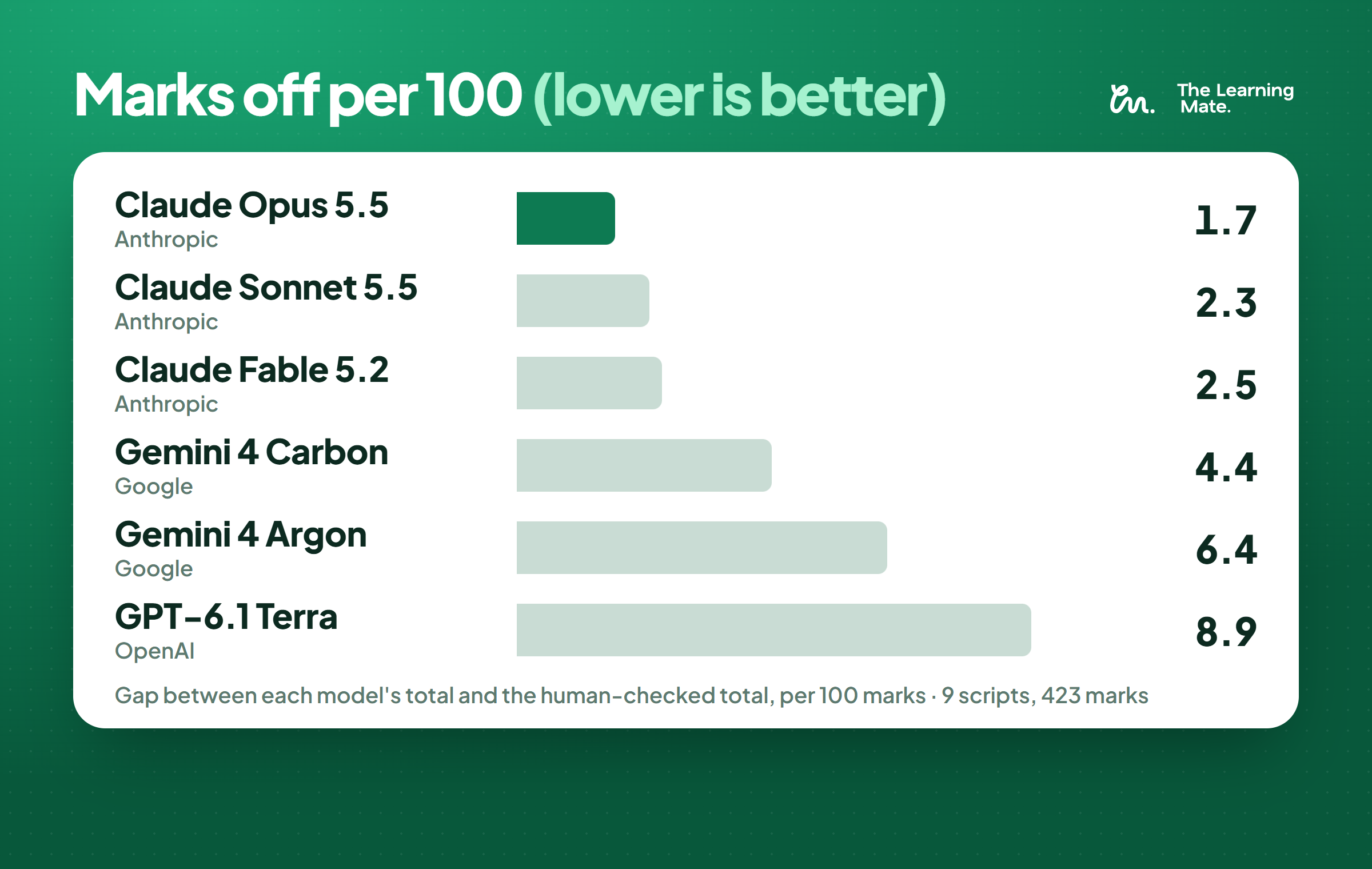
Accuracy is 100 minus the average gap between the model's total and the human-checked total, as a share of the marks available. A script out of 50 that the model marks 48 when the human gave 49 loses 2 points. Exact mark and Within 1 mark count questions and parts where the model gave exactly the human mark, or came within 1 mark of it. Within 3% counts scripts whose total landed within 3% of the human total. Time is the median per script.
Five things we learned
1. Claude Opus 5.5 came closest to the human examiner
Opus was off by 1.7 marks per 100 on average. It got the exact mark on almost 19 of every 20 questions, and 8 of the 9 script totals landed within 3% of the human total. On this sample, all three Claude models finished ahead of the Google and OpenAI models.
2. The most expensive model did not win
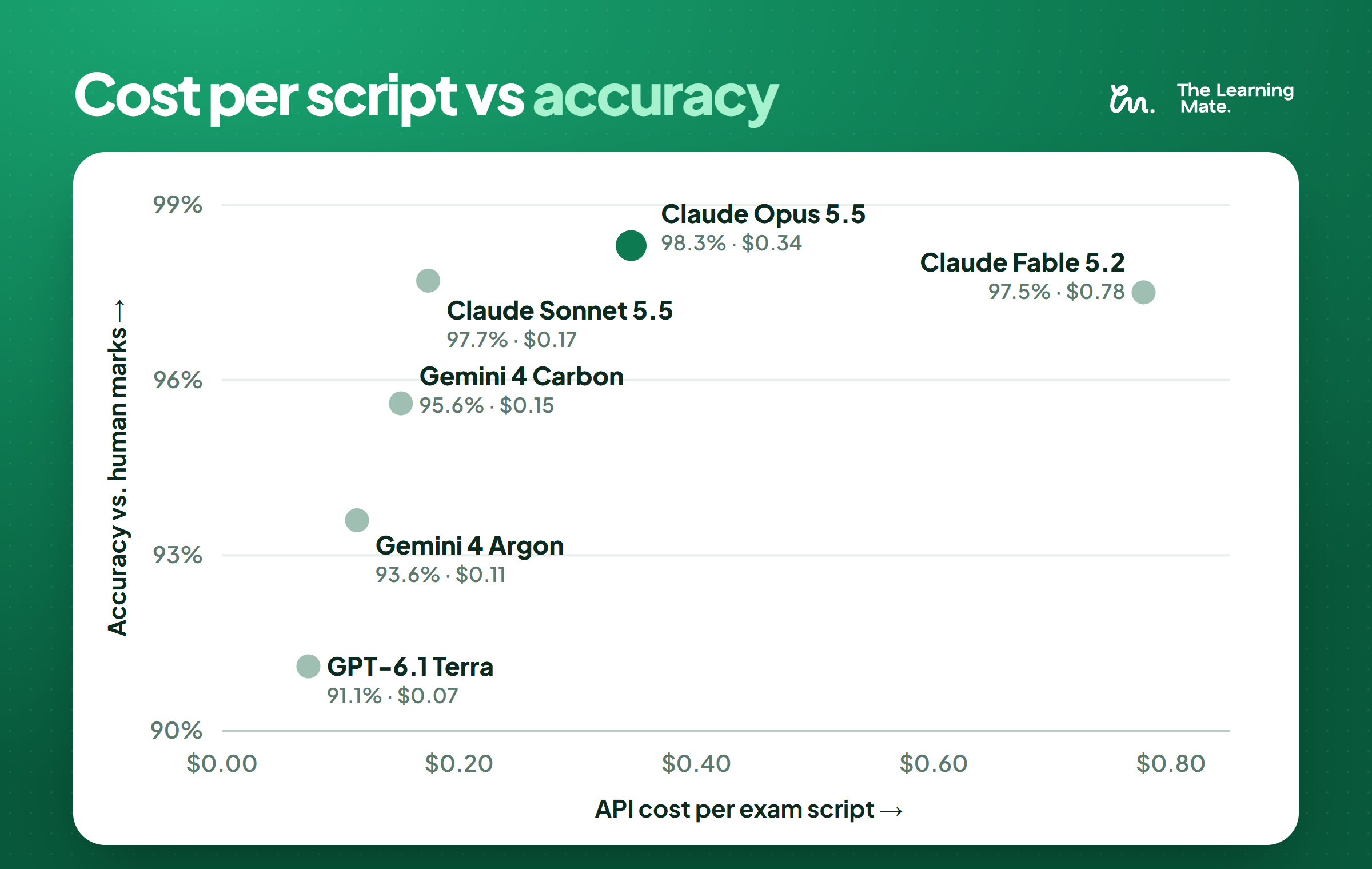
Claude Fable 5.2 is Anthropic's top-of-the-range model and costs about 2.3 times as much per script as Opus. It scored slightly lower and took longer. Marking a script is a reading-and-rules job, not a hard-reasoning job, so paying for extra reasoning didn't help here.
3. Close is easy. Exact is hard.
Four of the six models were within 1 mark of the human on 99.6% of questions. The spread only shows up when you ask for the exact mark: 83% to 95%. That last mark is where marking really happens. Did the student write enough for the second marking point? Is that a 7 or a 1? Does the method mark stand without the accuracy mark?
4. Handwriting, not judgement, causes most of the misses
In our earlier, larger tests on the same kind of scripts, most disagreements came from reading the script, not from applying the mark scheme. Examples are a word misread in cramped writing, an answer continued in a margin, or a crossed-out attempt treated as the final answer. A model that reads handwriting well marks well.
5. Cheap and fast isn't automatically worse, but here it was
GPT-6.1 Terra was the fastest and cheapest, at about 7 cents a script. On these scripts it also missed the most marks, and it was the only model that fell outside 1 mark on more than 5% of questions. Gemini 4 Carbon, Google's newest model, did clearly better than Gemini 4 Argon but took the longest.
How we ran it
- The scripts. 9 real student exam scripts, scanned from paper, in Computer Science, Chemistry and Biology. We don't publish the scripts or any student's answers, only the totals above.
- The ground truth. Marks checked by human reviewers, question by question. Human marks aren't perfect either: when we audited a larger set, a small share of human marks looked wrong. That puts a ceiling of a few percent on how "accurate" any model can look.
- The task. Each model received the scanned PDF, the question paper and the mark scheme, with the same instructions and the same structured marking sheet. Each one read the handwriting and marked in a single pass.
- Settings. Claude models ran at "high" effort. Gemini and GPT models ran at their providers' default reasoning settings.
- Costs are each provider's list API prices on 12 November 2026, for the tokens each model used. Gemini 4 prices are introductory until 30 November 2026.
- The sample. We ran 10 scripts. One script didn't finish for one model, so every number above compares the same 9 scripts. With a sample this size, a difference of a point or two between models could be noise. The full 100-script run will tell us more.
What this means if you mark with AI
- The model matters, and so does the setup. The best and worst models here were 7 points apart. Results also shift with the setup: whether the model sees the mark scheme, how the marking is structured and whether a teacher reviews the doubtful questions.
- Check the exact mark, not the vibe. A tool that is "nearly right" on every question can still move a student across a grade boundary. Ask any AI marking tool how often it gives the exact mark, and how you review the rest.
- Keep a teacher in the loop. Even the best model here missed about 1 question in 20. Good AI marking shows you which questions to check, so your time goes there.
If you want to see AI marking on your own scripts, try The Learning Mate free. Our guide to whether AI can mark handwritten IGCSE scripts covers what to look for, and we also compare general chatbots with dedicated marking tools.
FAQ
Which AI is best at marking exam papers?
In our pilot benchmark of real handwritten scripts, Claude Opus 5.5 came closest to human-checked marks. It averaged 98.3% accuracy on script totals and gave the exact mark on 94.7% of questions. Claude Sonnet 5.5 and Claude Fable 5.2 were close behind. The sample was 9 scripts, so treat this as an early result.
Is Claude better than ChatGPT and Gemini at marking?
On these scripts, all three Claude models scored higher than Gemini 4 Carbon, Gemini 4 Argon and GPT-6.1 Terra. GPT-6.1 Terra was the cheapest and fastest but missed the most marks.
How much does it cost to mark an exam script with AI?
At list API prices in November 2026, marking one scanned script in a single pass cost between about $0.07 (GPT-6.1 Terra) and $0.78 (Claude Fable 5.2). Claude Opus 5.5, the most accurate model here, cost about $0.34 per script.
Can AI read students' handwriting?
Mostly, yes. The best models were within 1 mark of the human on more than 99% of questions. Most of the remaining errors came from misreading handwriting, so it's still worth a teacher checking the questions an AI tool flags.
Will you publish the full benchmark?
Yes. We are running the same test on 100 scripts and will update this page with the results.